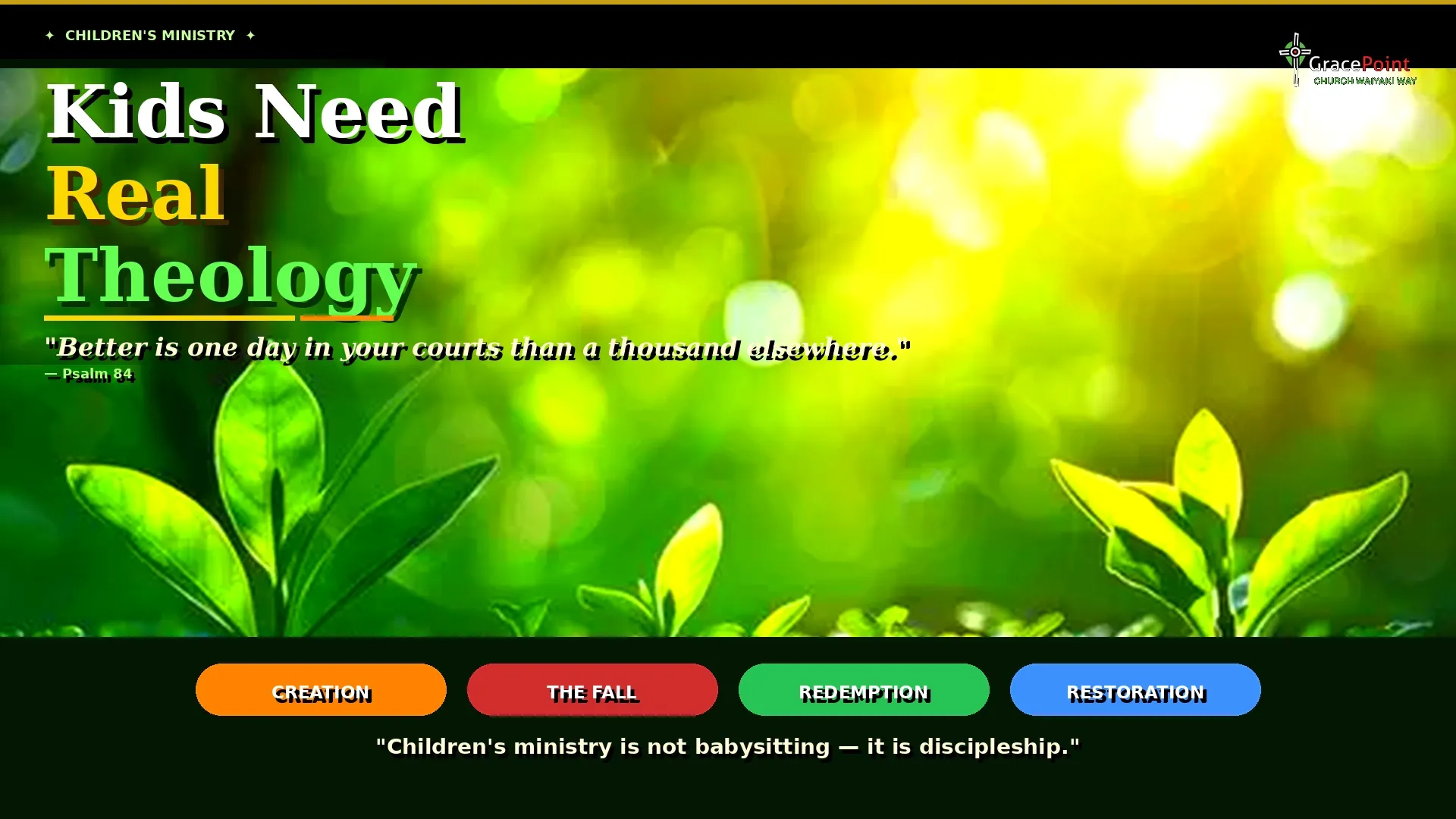

Reflections from the book, How to teach kids theology by Sam Luce and Hunter Williams)
Reflections By Grace Njuguna (Children Worker)
It is sad to see that in some places, Sunday school is viewed as a holding place to keep kids occupied so parents can have uninterrupted time during the church service. We do great injustice to children if this is the focus of our ministry. There is much more to do beyond keeping children occupied or teaching them to be good. They need to hear the gospel just as their parents do. They need to hear about God. They need theology. In the past, I thought theology was for specific people who were studying in a seminary somewhere, learning complex Bible concepts. However, I now understand theology is for everyone, including children. This book, How to Teach Theology, has inspired me to work harder on teaching children. I hope it challenges you to see that kids need to learn theology.
The Danger of a Small View of God
The book starts with a warning on why it is dangerous to give children a minimized understanding of who God is. Hunter Williams says
“Sunday school teachers, parents, and ministry leaders must work together to paint an accurate portrait of Christ, not a caricature of him. Caricatures overemphasize certain features of a person to the point of distortion. Their eyes are exaggerated, or their heads are drawn out of proportion to their bodies. We can do the same to Jesus. If we’re not careful, we can exaggerate his friendship to the neglect of his lordship or overly emphasize his love to the detriment of his holiness. Conversely, we can magnify Christ’s holiness to the denigration of his mercy and grace.”
Sometimes we may do this not because we lack knowledge that it is wrong, but because we are ill-prepared. It is always a joy for me at our church to see preachers wrestle with a passage. We also get to look at the same passage together as a staff team and give a few insights. I wonder whether we do the same for the children’s ministry work. Do we labour hard enough with a text? Do we wrestle with a passage to understand it first for ourselves and then think through how we teach it to children? Or are we the ones tempted to look at the lesson material the night before in a rush? Kids need a grand view of God that overwhelms their hearts so that they can stand against the pressures of this world. As children’s ministry workers, we need to work diligently on how we teach children. I love this quote from the book,
“Though the Spirit is the one who opens the eyes of a child’s heart, our efforts aren’t pointless ;We may not be able to control what children believe, but we can control what we teach them. We can deliberately teach them what is true or casually teach them what is easy. We can give them a simplistic caricature of God, or we can give them a realistic picture of who he is.”
Moving Beyond Simple Bible Facts
So, with that understanding, what are we supposed to do? The Bible is not just a reference book we consult to see how God meets our needs, but a resource we use to learn more about God. It is important that we acknowledge the Bible as one big story. There are four sections of this big Bible story highlighted in this book: creation, the fall, redemption, and restoration. We therefore need to ask these four questions as we look through a Bible passage.
- How does the framework of creation impact the story you are teaching?
- What conditions of the fall come to the surface?
- Is redemption displayed, and how does Christ accomplish the same thing but better?
- Was anything restored in the story, and how does that foreshadow the ultimate Restoration to come?
Sunday school lessons can easily become fact-checking sessions instead of opportunities for heart transformation. To teach children faithfully, we must first understand the passage deeply and then think carefully about how it applies to their lives. One helpful way to do this is to spend time with children and understand the challenges they face. Parents may do this naturally, but others can intentionally create opportunities to interact with children through conversations, school visits, or time with families. Knowing children well helps us teach scripture more meaningfully.
Distillation not Dilution
On Kenyan highways, there are road reflectors, small safety devices along centerlines or lane edges, that warn drivers against drifting out of their lanes. I have only a few years of driving experience here, but as a new driver, those reflectors helped me from veering off. In teaching children, we need similar markers/reflectors to stay biblically faithful while helping them understand the Bible. A seasoned children’s Bible teacher once told me, ” Do not teach a child what you will have to make them unlearn in future.” This means we should not omit essential parts of a story, even if they are considered too complicated for children.
As Sam Luce puts it, we need to separate simplification from distillation. Simplification is when we pick and choose what to include in a passage, which may mean leaving out important details. Simplification in theology adds what is unnecessary and removes essential elements to make sure what you are teaching is understandable. However, distillation means keeping the key details of a passage and omitting the secondary ones. This means we do not omit complex concepts. Our aim in this case is to break down those complicated concepts rather than avoid them. Sam goes further to say,
When we tell the hard stories and the difficult ones, our kids will understand that God is not a God we control, and sometimes, our kids won’t be able to understand fully. They will, however, grow into an understanding of a powerful, gracious, loving, and holy God that loves us more than we could ever know. This is the danger of simplifying faith. We try to make it so accessible and safe that we inadvertently inoculate our kids from faith. They get just enough of God that when life hurts, our kids apply what they learned about God, but it isn’t a robust, powerful, unsafe, good faith that they apply. The simple faith they grew up in isn’t powerful enough for the deep sorrows and dark nights. They tried faith, and it didn’t work.
A Final Encouragement
Children are not the future church; they are part of the church now. Every Sunday, we stand before young hearts that are forming their understanding of God, sin, grace, truth, and the gospel. That responsibility should humble us. May we never settle for entertaining children when we have the privilege of introducing them to the greatness of God. Let us teach scripture carefully, faithfully, and passionately, trusting that the Lord uses his Word to save and transform even the youngest hearts. Children’s ministry is not babysitting. It is discipleship.